
In many industries today, machines no longer simply carry out commands. They ‘see’, analyse, make decisions… and sometimes even move around on their own. Behind these capabilities lie two technological pillars: machine vision and autonomous navigation.
These are topics we explore on a daily basis in our design office, and one thing often comes up: the terminology is quite technical. So here is a simple, practical glossary to bring a bit of clarity to it all.
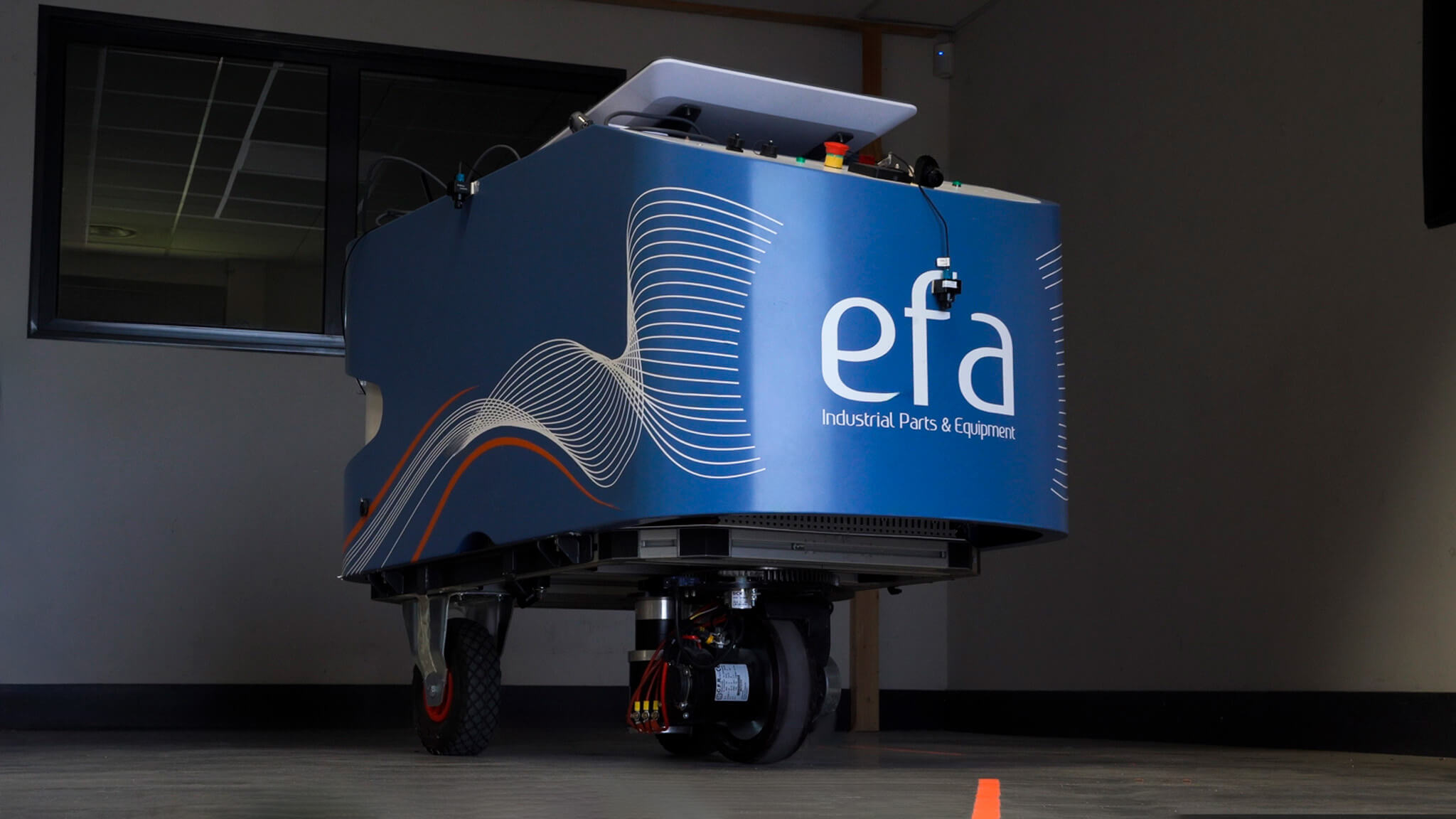
Autonomous navigation: moving without direct intervention
Autonomous navigation refers to a system’s ability to move around on its own within a given environment.
Contrary to popular belief, it is not a single technology, but a coherent set of components:
- sensors (cameras, lidar, radar, GPS, etc.)
- software capable of understanding the environment
- algorithms that determine the route to follow
- systems that physically control the vehicle
It is this combination that now enables logistics robots to move around warehouses, or industrial machinery to assist operators with their manoeuvres.
Insight: making sense of data
Perception is often the first building block of the system.
In practical terms, this is the moment when the machine transforms raw data into actionable insights. An image becomes an obstacle, a shape becomes a person, an area becomes passable or impassable.
This is a crucial step: without reliable perception, all subsequent decisions are fragile.
Location: knowing exactly where you are
An autonomous machine must know where it is at all times.
To achieve this, several technologies can be combined:
- GPS or GNSS for global positioning
- inertial sensors to track movement
- cameras or lidar to orientate itself within the environment
- odometry to measure displacement
In industrial environments, reliance on a single sensor is generally avoided. Redundancy is essential to ensure accuracy and robustness.
Machine vision: when machines learn to see
Machine vision encompasses all the technologies that enable a machine to interpret what is happening around it using visual sensors, most commonly cameras.
But capturing an image is not enough. The real challenge lies in the processing. Algorithms analyse these images to extract useful information:
- detecting an obstacle in a path
- identifying an object or piece of equipment
- estimating a distance
- detecting a human presence
In practice, this is what enables, for example, a robot to avoid collisions, or a machine to position a load precisely.
Beyond performance, it is also a major driver for improving safety and automating tasks that were previously dependent on human intervention.
Mapping: constructing a representation of the world
Before a machine can navigate intelligently, it must first understand its surroundings.
Mapping involves creating a digital representation of the environment:
- accessible areas
- fixed obstacles
- waypoints
Depending on the situation, this map may be prepared in advance (static) or updated continuously (dynamic).
It is on this basis that the machine will be able to plan its movements.
Sensor fusion: combining data for greater reliability
No sensor is perfect.
A camera can be affected by light conditions, a lidar by certain surfaces, and a GPS by the environment.
Sensor fusion involves combining multiple sources to achieve a more reliable and comprehensive view. For example:
- combining a camera and lidar to better detect obstacles
- cross-referencing GPS and inertial data to stabilise positioning
This is often what makes the difference between a system that works ‘in the lab’ and one that is truly robust in the field.
SLAM: finding your way whilst exploring
SLAM (Simultaneous Localisation and Mapping) is a particularly interesting approach.
The idea is simple in theory: the machine builds its map whilst simultaneously determining its own position within it.
This is essential in environments that are:
- unknown
- changing
- unstructured
This technology is used in many practical applications, ranging from mobile robots and drones to certain types of industrial equipment.
Path planning: choosing the right route
Once the machine has mapped its environment and knows where it is, the next step is to decide how to move.
Path planning involves calculating the optimal route, taking into account:
- obstacles
- the map
- vehicle constraints (speed, turning radius, stability, etc.)
It is not just a question of efficiency. It is also a matter of safety and the smooth running of operations.
Remote working: keeping people in the loop
Full autonomy is not always desirable, nor even possible.
Teleoperation allows an operator to take control remotely, using video feedback and dedicated interfaces.
This is particularly useful in:
- hazardous environments
- complex situations
- transitional phases towards greater autonomy
In practice, many systems combine autonomy with human supervision.